Your car will stop on W Jefferson St
The curb at your pin is a no-stopping zone. It's a 2-minute walk, and the car will wait for you.
Cancel ride
Look for HJ on the roof
White Jaguar I-PACE · AZ 7KL 204
Doors unlock when you're next to the car
Your car is here
2:40
left to board
Timer pauses while you're walking toward the car
Cancel ride
Helping riders find, recognize, and board a car that has no driver.
The pickup is the hardest moment of an autonomous trip. There's no driver to wave, call, or pull up a little further, so the rider has to solve it alone.
A self-initiated concept, grounded in my own first Waymo ride and desk research, designed as a reusable pattern for a ride-hailing platform working with many AV partners.
Type
Concept project
Timeline
Oct 2026
Role
UX design · Prototyping in code · Research · AI
Journey map · my first Waymo ride, Phoenix
Easy to book, hard to board.
The car stopped three blocks from my pin. I ran to find it, afraid it would leave before my flight.
What exists today
The pieces exist. Riders still can’t see the reasons.
Waymo’s own app picks a spot the car can reach, lets riders drag the pin along allowed segments, shows initials on the roof dome, can honk or play a melody, and gives a 5-minute countdown before a no-show fee.
Waymo on Uber matches riders instead of letting them choose, gives 7 minutes to board, and moves unlock and horn into the Uber app.
Other partners differ again: fixed venue zones (Zoox, Motional), safety operators on board (WeRide downtown, Wayve), and waits of up to about 15 minutes (Tesla). Uber has more than 30 AV partners.
What riders say
- 1“You basically have to chase it to the next pickup location that you didn’t even agree to.” r/waymo
- 2“They give you 5 minutes to FIND the car after the app says it arrived.” Charged a $4.95 no-show fee. r/Scottsdale
- 3“Now I’ve got to walk down a sketchy alley at night and can’t hail it to come closer.” r/waymo
- 4“Just before pickup… app said they were sending me a different one. They should provide an explanation at minimum.” r/waymo
- 5“I checked the plate, and it was not the car I had ordered.” r/waymo
Why the car can’t just pull up
- 1It follows the law: red curbs, bus stops, and bike lanes are off-limits or allow only short waits.
- 2It still gets ticketed: 8,309 parking tickets in San Francisco in 18 months, clustered at pickup hotspots.
- 3Places change by date: the city geofenced AVs out of whole neighborhoods during Fleet Week.
- 4Remote help isn’t remote driving: agents advise the car, but it stays in control.
Riders who can’t see the car
- 1Blind and low-vision riders are among AVs’ most enthusiastic users. Without a driver to help, finding the car is the hardest step.
- 2A survey of 202 blind and low-vision travelers put knowing the make and model, and finding the right car, at the top (Fink et al., 2025).
- 3“We had to run to make it within the 5 minutes… I’m blind and if it were just me by myself I wouldn’t make it.” r/waymo
Insight
The car knows why, how long, and which one. The rider is left guessing, and the rules change with every partner.
Spot changes arrive without reasons. Countdowns run while riders are already hurrying. Signals, wait times, and zones differ between partners and even between apps for the same car.
Problem statement
How might riders confidently find, recognize, and board a car with no driver, across AV partners and messy real-world streets?
Without a driver, the pickup’s small negotiations (where exactly, how long, which car, can I get in) fall entirely on the rider.
The car knows the answers. It knows where it can legally stop, how long it can wait, and what it’s doing. Riders just can't see them, and every AV partner shows them differently.
Design principles
- 1Say where, and why. If the car can't stop at the pin, tell the rider early, show the walk, and give the reason in plain words.
- 2Make time visible. Show exactly how long the car will wait, and let riders ask for more, so no one runs in fear.
- 3One signal, two screens. The phone and the car show the same initials and color, so recognition takes a glance.
- 4Show intent, not just perception. Beyond what the car sees, say what it's doing, why, and what it means for the rider's goal.
Explorations
Three directions: who adapts, the car or the rider?
Direction A
Bring the car to me
The car works harder to stop right at the pin.
- ✓Least walking
- ✓Best for luggage and limited mobility
- ✕Slower pickups, more circling
- ✕Still can't break curb rules
Direction B
Guide me to the car
The phone leads: spot update, walking guide, fair timer.
- ✓Works with every AV partner
- ✓Fast to ship
- ✕Recognizing the car is still hard
Direction C
Let the car say hello
The car leads: your initials and color, honk, unlock on approach.
- ✓Instant recognition
- ✓A real physical-digital moment
- ✕Depends on each partner's hardware
- ✕Only helps once you can see the car
| Criteria | A · Bring the car | B · Guide me | C · Car says hello | B + C · Pickup handshakeChosen |
|---|---|---|---|---|
| Rider effort | ●●● | ●●○ | ●●○ | ●●○ |
| Confidence it's my car | ●○○ | ●○○ | ●●● | ●●● |
| Works across AV partners | ●●○ | ●●● | ●○○ | ●●● |
| Operational cost | ●○○ | ●●● | ●●○ | ●●● |
| Speed to ship | ●○○ | ●●● | ●○○ | ●●○ |
| Accessibility | ●●● | ●●○ | ●●○ | ●●● |
●●● strong · ●○○ weak. Scored from research evidence, not tested with riders yet.
The choice
A pickup handshake: the phone guides you to the car, and the car greets you.
B and C solve different halves of the problem. B gets riders to the right place in time; C makes the last few meters certain.
Combined, they cover every stressful moment from my ride. They layer cleanly too: B works with every partner on day one, and C lights up wherever the car’s hardware supports it.
A’s best idea, saying early where the car will actually stop, carries into the first screen. Its costly circling doesn’t.
Prototype
Play the pickup, end to end.
Built in code, so it runs right in the browser. It plays on its own; tap the screen to take over and press the real buttons.
Your car will stop on W Jefferson St
The curb at your pin is a no-stopping zone. It's a 2-minute walk, and the car will wait for you.
Cancel ride
1 · The spot moved, and why
Tap the screen to try it yourself
Solution
Five moments, from “where is it?” to “I'm in.”
Some pieces exist in one partner's app today, like initials on the roof and a honk button. What's new is giving riders the reasons, making the clock fair, and making the whole handshake work the same way with every AV partner.
Your car will stop on W Jefferson St
The curb at your pin is a no-stopping zone. It's a 2-minute walk, and the car will wait for you.
Cancel ride
1 · Say where, and why
- 1The moment the car knows it can't stop at the pin, the rider sees the new spot, the walk, and the reason: a no-stopping curb.
- 2Today, riders are told to walk but never why. One called it chasing a pickup “you didn't even agree to.”
- 3“Choose another spot” keeps the rider in control.
2 · Guide me there
- 1Turn-by-turn walking directions with a landmark and a pointer, not just a pin on a map.
- 2Arrival and wait time stay visible the whole way, so the rider never wonders.
80 m
Turn left at Copper Coffee
Stop guiding
Your car is here
2:40
left to board
Timer pauses while you're walking toward the car
Cancel ride
3 · Make the clock fair
- 1The countdown pauses while the rider is actively walking toward the car, so no one is charged for searching.
- 2“Need 2 more minutes” gives riders a way to negotiate, like they would with a driver.
- 3The trip goal stays in view: “On track for your 11:30 flight.”
4 · One signal, two screens
- 1The rider's initials and color glow on the roof display and the phone at the same time, with the make and plate for a second check.
- 2Honk and Flash lights help in crowded spots or at night, and give blind riders an audible target.
- 3“Doors unlock when you're next to the car” answers the unlock worry before it starts.
Look for HJ on the roof
White Jaguar I-PACE · AZ 7KL 204
Doors unlock when you're next to the car
Doors unlocked
Get in on the curb side. Buckle up and tap Start on the screen when you're ready.
5 · Confirm I'm in
- 1A clear confirmation the doors are open, and which side to enter from.
- 2“I can't get in” goes straight to help, without searching.
During the ride
From “what the car sees” to “what the car is doing, and why.”
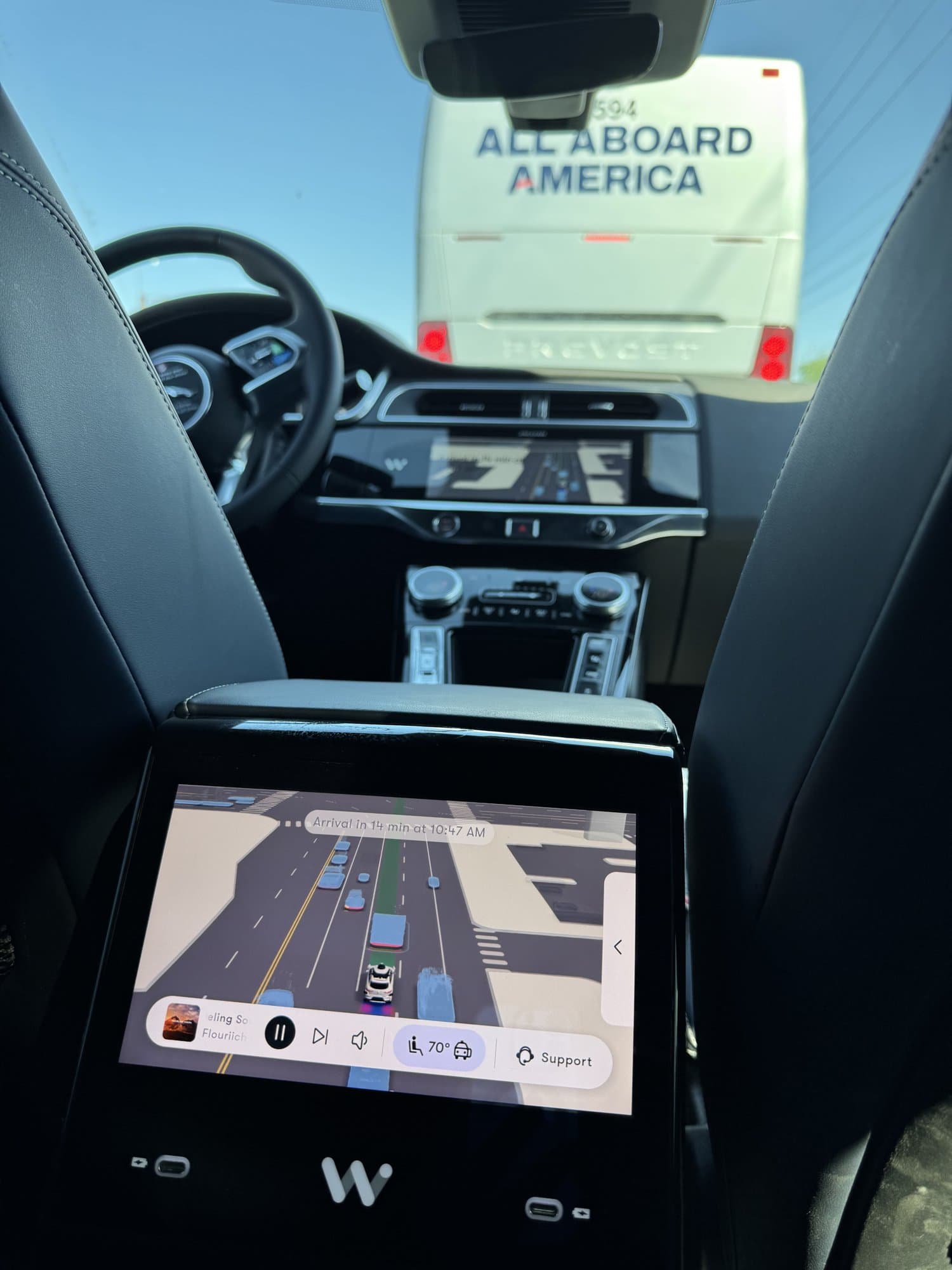
Today’s rear screen shows the road and an arrival time. The redesign adds the car’s intent and ties arrival to the rider’s goal.
Today
It shows what the car sees, not why it's doing it.
Redesigned
Waiting behind a stopped bus
Moving again in about 20 seconds
Arrive 10:47 AM
On time for your 11:30 flight
Reroutes, explained
Say why, and what it means for my trip.
When the car changes course, it names the reason and the cost, and confirms the rider is still on time.
Rerouting around construction
24th St is closed. This adds 1 minute.
Arrive 10:48 AM
On time for your 11:30 flight
One pattern, many AV partners
- 1Level 1, every partner: spot update, walking guide, wait timer, and goal-aware arrival. These need only trip data and the phone.
- 2Level 2, basic vehicle signals: honk, flash, and lights in the rider's color, wherever the partner exposes them.
- 3Level 3, exterior display and intent: initials on the roof and “what I'm doing” messages, for partners whose cars can share them.
Designed as one component with capability levels, so the experience degrades gracefully instead of breaking.
Riders get the same mental model in every car. Each partner adds richer signals as its hardware allows.
How I'd measure success
- 1Arrival to boarding time: how long the car waits once it's at the curb.
- 2Missed pickups: trips cancelled because the rider couldn't find or reach the car in time.
- 3Pickup support contacts: “where's my car” and “I can't get in” tickets.
- 4Walking distance: the gap between the pin and where the car actually stopped.
- 5First-ride confidence: a one-question survey after a rider's first AV trip.
What's next
- 1Test with riders: ride-alongs with 5 first-time AV riders, including one airport trip.
- 2Accessibility: haptic and audio guidance for blind and low-vision riders finding the car.
- 3Harder pickups: groups, luggage, airports, stadiums, and night-time.
- 4When things go wrong: support for a stuck car or a lost item, building on my CRM work at Remitly.